
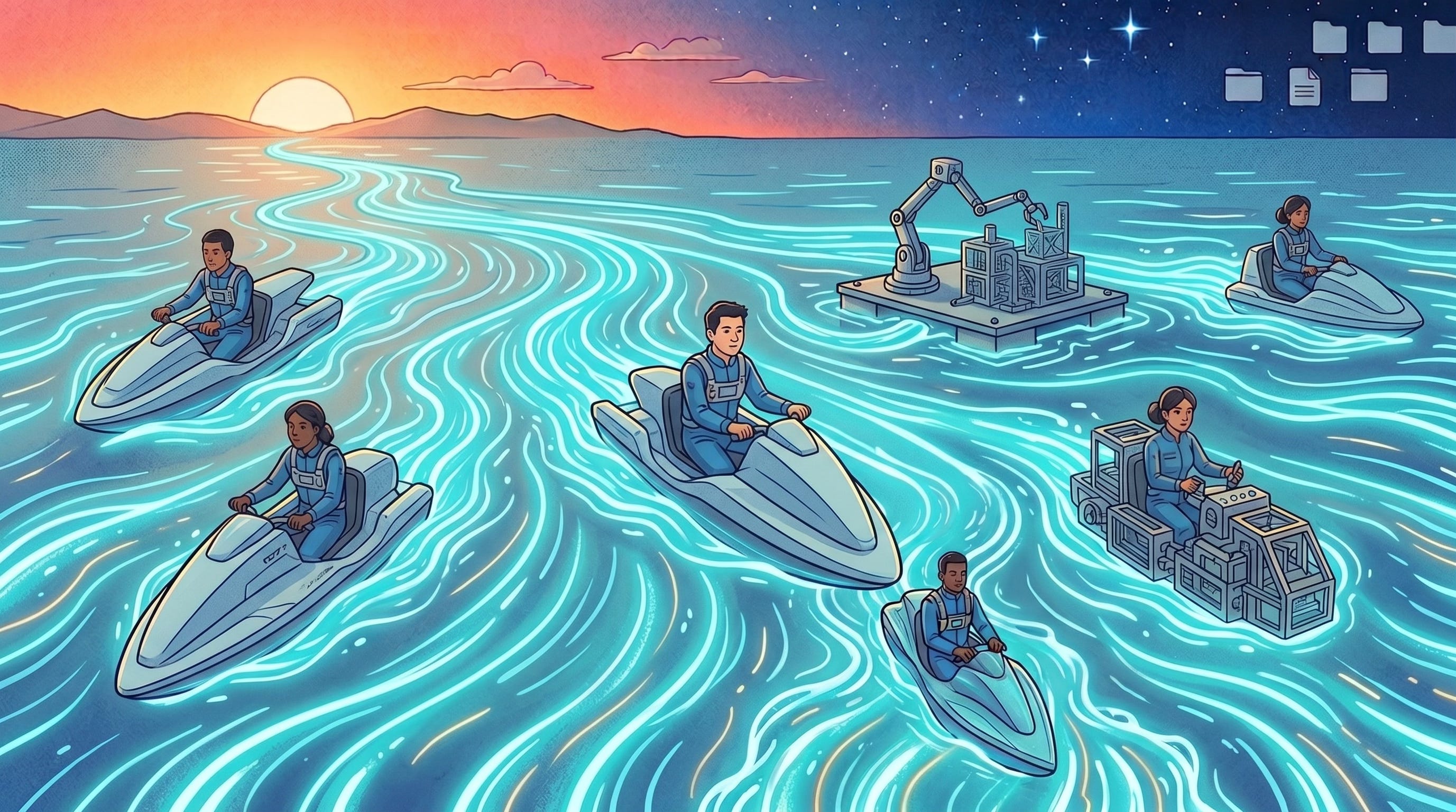
Lately I’ve been noticing the designers around me are all doing their work differently.
A few years ago we all used roughly the same tools in roughly the same order. That isn’t true anymore. And my sense is it isn’t coming back. The shared shape of how design gets done is breaking down.
The shared workflow is dissipating
For a while, product design as a profession had a shared shape. You opened couple of software tools like Figma, and moved through some version of discovery, exploration, refinement, handoff. You could move between companies and pick up someone else’s file without much translation.
Recent adoption of AI in workflow seems to show that we are moving towards a hyper-personalization of design workspace.
The reason isn’t that any single tool got disrupted. It’s that the conditions that made convergence valuable have changed. When everyone was solving roughly the same problem at roughly the same speed, sharing a toolchain made sense. The cost of switching to a teammate’s file was low. The cost of training someone new was low.
None of those costs are low anymore, because nobody’s solving the same problem at the same speed. So the tools fragmented to match.
Big tech
In big tech, the workflow looks heavy because the company is heavy.
Years of decisions live in Figma files. Patterns that nobody documented but everyone knows. Components that were forked three times for reasons nobody remembers. Design systems that are partially adopted, partially abandoned, partially in maintenance. None of it lives in a place you can search. It lives in people, and in the rituals those people use to maintain it.
Design crit is the main ritual. The job of crit has been driven to maintain the bar. When you sit through enough crits, you start absorbing the unspoken rules. What counts as too dense. What counts as too sparse. Which patterns are blessed and which are tolerated. The bar is fluid and undocumented, and that’s the problem.
It’s also why the vibe-design tools don’t slot in cleanly here. You can prompt a tool to produce a screen that looks fine in isolation, but it won’t match the bar. The bar lives in the heads of the people in the room. Until that bar is encoded somewhere a tool can read, the tool will keep producing work that needs to be rebuilt.
So Figma stays and leaving cost is too high. Not because Figma is irreplaceable, but because everything that surrounds Figma, all the unspoken context, would have to be rebuilt from scratch on the other side.
The transition is happening anyway, just slowly because more things are at stake. I see it in pieces. An engineer who used to wait on a spec now generates a working component and brings it to a design review. A PM who used to write a doc now ships a prototype. The file is becoming one input among several, instead of the source of truth. Increasingly, the work is less about producing artifacts and more about coordinating decisions across humans and machines.
Some of this is happening at the company level, not just the individual level. Coinbase, Netflix, Meta, Google, Uber and countless more are all rebuilding parts of their workflow around AI, at different velocities. The pattern that keeps showing up is a centralized internal tool for prototyping or exploring with code, often equipped with the company’s design system. The bet is that if the design system lives inside the prototyping layer, the speed of AI tooling becomes compatible with the bar designers maintain through crit. Whether that pays off is unclear. It’s clearly the move that big tech companies are making.
Startups
In a startup, the workflow looks light because there’s nothing to maintain.
There’s no design system to defend, nor legacy components that someone might still be using. No design crit because there are two designers and they’re both in the same Slack DM. There’s no bar to maintain because the company hasn’t decided what its bar is yet. So they may go from an idea to a working interface in an afternoon. The artifact that used to be the design (the pixel-perfect Figma frame) is now whatever the build actually looks like.
Building a feature can be drastically compressed into well-prompted vibe code… with clear style guide, some revisions that can be evolved into production code by the next morning. The team moved that fast because there were no precedents to maintain. Maybe reckless, but it’s the only way to move at the speed a startup needs to move.
Design firms
Design firms (or consultancies) are the third case, and they’re the strangest one to map. They don’t have a single workflow because they don’t have a single client.
If the client is a big-tech team, the firm plugs into that company’s Figma file, its component library, its crit cadence. If the client is a startup, the firm ships in whatever tool the startup uses, which might be nothing at all. The firm’s workflow is the union of every workflow it touches.
What’s changing fast for design firms is what pixel-pushing is worth. A new wave of design agents shipped this year, Figma and Pencil.dev among them. They can take a rough layout and clean it up, apply a style system, generate variants, push the polish through. The kind of work that used to be a junior designer’s first six months can be done in an afternoon by someone who knows how to direct an agent.
This is good for design firms in one way and bad in another. The good is that the same team can take on more work. The bad is that the rate they charged for that work is about to compress. What design firms sell has to move up the stack toward direction and judgment.
The toolchain is now personal
The thing that all designers share is that none of them has a default that the others would recognize. There isn’t a workflow you could write down and hand to a new designer and say, this is how we work. Every designer is constructing their own setup.
Each tool setup hooked up to an internal database and tools allow these prototypes and designs to feel closer to live products. The choice of tools is a choice about how you think, what you value, what kinds of problems you need to spend time on.
A few years ago, the toolchain was an environment you walked into. You picked up what was already there and got to work. Now the toolchain is something you build, maintain, and revise. Two designers can open the same tool and still be running entirely different workflows inside it. It’s part of the work. Not a setup step before the work.
The cost
There’s a cost to this that’s worth saying out loud. The reason big tech feels slow isn’t that it hates innovation. It’s that shared workflows cut coordination cost, and once everyone has their own setup, that cost reappears as something else. Review takes longer when the reviewer doesn’t recognize the tool. Onboarding takes longer when there’s no team standard to learn. Trust takes longer to build when no two designers’ outputs look the same on inspection.
The flexibility of the personal workflow is paid for somewhere. Right now most teams are still figuring out where.
Curiosity is the skill
If the toolchain is now personal, the skill that lets you build and maintain a good one becomes the skill itself.
What I mean by curiosity isn’t taste. It isn’t being well-read about design. It’s the willingness to spend time on tools that probably won’t stick, to test something and abandon it, to come back to it three months later and re-test it because the context changed. It’s a tolerance for the friction of being a beginner over and over.
The cost of trying a new tool feels high in the moment. The cost of not trying any new tool, for two years, is invisible until it isn’t. By the time it’s visible, the gap between you and someone who’s been compounding curiosity is structural.
This connects to something I wrote in a previous essay about the floor rising. The floor keeps rising because tools keep getting better and more accessible. The risk isn’t failing to adopt every new tool. It’s staying inside a workflow optimized for conditions that no longer exist. Curiosity is what lets you keep moving. Agency is what lets you act on what you learn without waiting for the org to catch up.
What I keep getting stuck on
If the work increasingly looks like personal R&D on your own setup, what does it mean for design as a profession?
Hiring assumes a shared stack. Mentorship assumes you can teach a junior the way things are done. Design education assumes there’s an it to teach. None of those assumptions hold cleanly anymore. If everyone’s workflow is different, what’s the curriculum?
One answer I keep coming back to is that the curriculum has to move up a layer, to design at the level of principles. If you understand why a thing should be built a certain way, you can carry that across whatever tool you happen to be in: build the aesthetic sense first, treat tools as instruments of thinking, stop fearing unfamiliar problems. The designers who navigate the fragmentation well aren’t the ones who picked the right tools. They’re the ones who can tell you why a decision is the right one, and could defend it across any toolchain.