
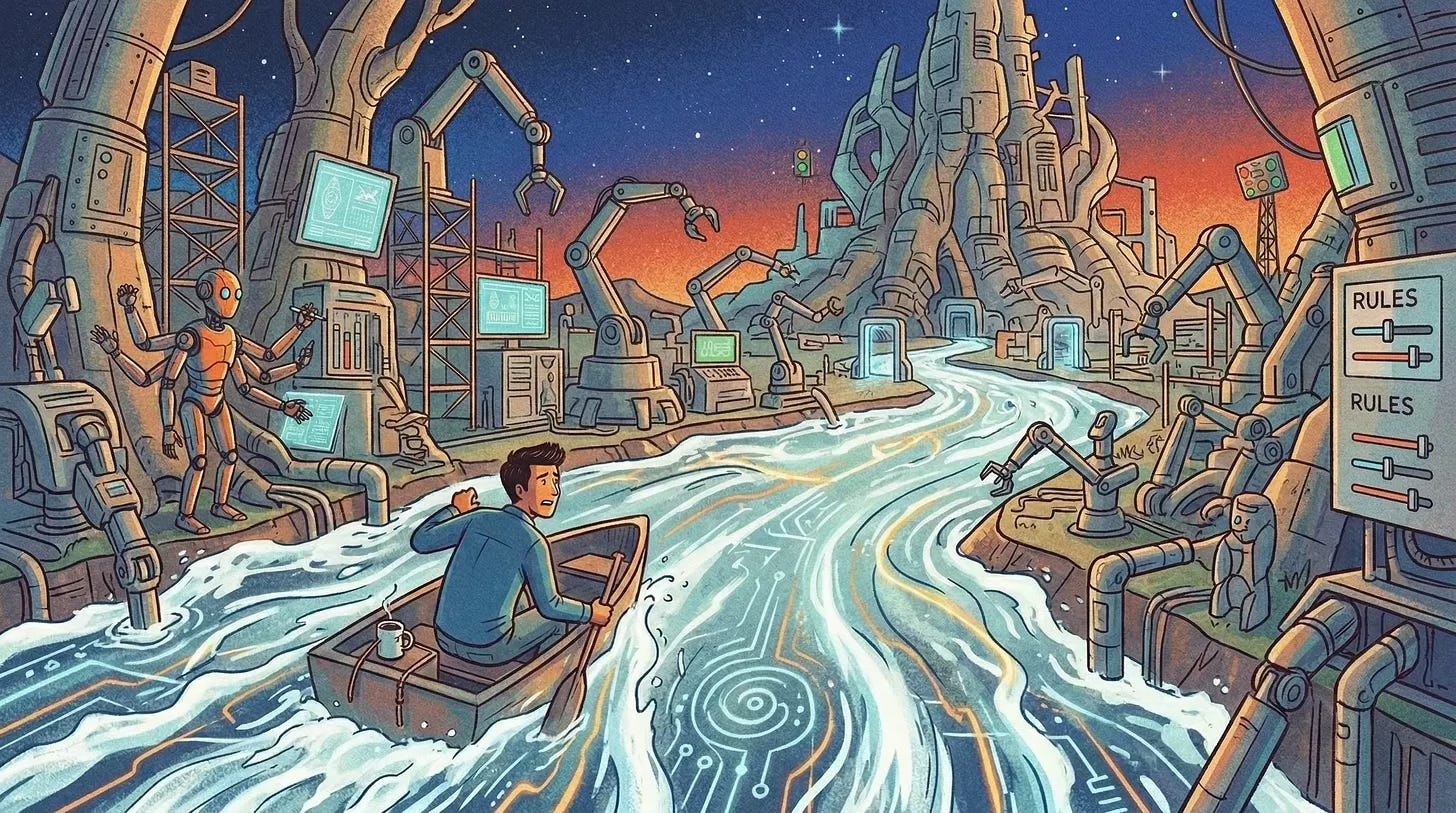
At some point I started feeling like there’s no comfortable middle ground left.
But I should clarify what “middle” means first. It’s the people who’ve stopped growing in an environment that keeps accelerating. That position is disappearing.
Tools cut in two directions at once
Every time a new tool arrives, two things happen at the same time.
The floor drops. Work that used to require specific skills or specific tools opens up to more people. At the same time, the ceiling rises. People who were already good at the work can now produce output at levels that weren’t possible before.
These two aren’t opposing forces canceling each other out. They happen together.
Figma is a good example. Before Figma, design files lived in a world that required particular software and a particular skill set. After Figma, it became normal to see a PM sketching a wireframe directly, an engineer pulling specs straight from the design file, a whole team collaborating on the same canvas at once. The floor came down. At the same time, designers who were good at Figma started shipping work through component systems, auto-layout, shared libraries; much faster and more precisely than before. The ceiling went up.
AI seems to be repeating the same pattern at a much larger scale. A few lines of prompt and a basic screen appears. A designer with strong taste and judgment can use the same tool to do in hours what used to take weeks.
If the floor keeps rising, what happens to someone standing still on it?
The middle disappears
The risky position isn’t the average designer. It’s the person who’s stopped growing.
Standing still in an environment where the floor keeps rising isn’t getting worse in absolute terms; it’s falling behind in relative terms. The floor rises toward you. The middle disappears not because average people are getting pushed out, but because the floor is catching up to them.
Three directions
So where do you go? For now, I see three directions. All three feel valid, and all three compound.
Direction 1: Product builder (the trinity)
Someone who can write and ship code. Design and run experiments. Read and interpret data. Understand and make calls on business context. PM, designer, and engineer fused into one person.
The point isn’t mastery in each area. It’s reducing the cost of coordination between them. Value comes from one person carrying the entire product loop without losing context. Stack a few years in this direction and the experiences in each area start crossing over and reinforcing each other. Knowing code changes how you make design judgments. Being able to read data changes how you make product decisions.
Direction 2: Taste-maker
A specialist with years of accumulated experience and a sharp sense of taste. Centered on product design, but fluent enough in the languages of motion, visual, and brand to move across them.
What’s hard for AI to replace isn’t output capacity. It’s the direction of the output, the sense of where it should go. The faster AI produces average output (AI slop), the more valuable it becomes to be the person who can point toward something clearly better. This person sets direction, and that judgment also compounds.
Direction 3: Domain expert
Someone deeply rooted in a specific industry. Healthcare, fintech, education, commerce — whatever it is.
How users in that industry actually think, how regulation actually plays out, what context shapes a real product call. These aren’t things you can easily get download of. They get internalized through years of working inside it. AI can generate information about an industry, but it can’t replace the judgment built up by actually working in one. If you genuinely like the domain and stay in it, that accumulation itself becomes a form of irreplaceability.
Whichever direction you choose, I think experience compounds.
What you can do now
AI tools change too fast. Workflows differ from person to person. What worked a few months ago might not work now. But we can build the habit of mapping the edges ourselves.
What are this tool’s limits right now, and what combination fits the way I work?
Has that shifted since a few months ago?
The gap between people who keep asking these questions and people who don’t will widen over time.